The Birth of a Trend: Deciphering the Maternal Metaphors and Rare Omens of the BIST 30 Downturn
1. Introduction: The Language of the Tape
The stock market is rarely a simple line of numbers; it is a living narrative, written in a visual language of shadows and wicks. To the trained eye, candlestick charts are not just data points—they are the “tape” of human emotion, capturing the tug-of-war between fear and greed in real-time.
Currently, the BIST 30 index (XU030) is navigating significant bearish pressure. Since our system issued a SELL signal on February 17, 2024—when the index stood at 15633—the market has retreated to 15279. This -2.27% slide serves as a somber backdrop for our current analysis. By looking past the raw percentages and into the psychological structures of recent signals, we can uncover the most impactful lessons hidden within the Turkish equity market’s recent movements.
2. The “Pregnant” Chart: Deciphering the Harami Pattern
In the current landscape of the BIST 30, the “Harami” pattern has emerged as a recurring motif, appearing in the charts of the index itself, as well as major players like EREGL and YKBNK. This pattern relies on a powerful visual metaphor to signal a potential shift in market momentum.
“This pattern consists of a black body and a small white body that is completely inside the range of the black body. When outlined, the pattern resembles a pregnant woman, which is not coincidental. The term ‘Harami’ is derived from an old Japanese word meaning ‘pregnant.’ In this analogy, the black candlestick represents ‘the mother,’ and the small candlestick represents ‘the baby.'”
For the sophisticated investor, it is vital to distinguish between the two variants currently at play. In the case of XU030 and EREGL, we see a Bullish Harami (a black “mother” and white “baby”), suggesting that the bears may be tiring at a potential bottom. Conversely, YKBNK recently confirmed a Bearish Harami (a white “mother” and black “baby”), signaling the birth of a correction after a rally. In both cases, the imagery represents a period where the prevailing trend has birthed a new, smaller range of price action, suggesting momentum is becoming contained. However, a “baby” is not a runner; the system requires secondary confirmation before a full trend reversal is recognized.
3. The Outlier: A 75% Gain in a Bear Market
While the broader index has shed over 2% since its mid-February SELL signal, one security has spectacularly defied the gravitational pull of the bear market: DSTKF (DESTEK FINANS FAKTORING). Since receiving a BUY signal on January 21, 2026, DSTKF has skyrocketed by +74.96%.
What makes this performance remarkable is its timing. While the system was shouting “STAY IN CASH” for nearly the entire market, DSTKF continued its climb. However, a “Bearish Deliberation” pattern has now emerged—a formation of three white candlesticks with higher closes that suggests the bulls are beginning to hesitate. Though the mandate remains STAY LONG, the “Delayed Intraday Module” has been switched ON. The system warns that the chance of a bearish confirmation is now “very high,” creating a high-stakes environment where we ride the winner while keeping a finger on the trigger.
4. Rare Omens: The Bearish Tri Star
In the case of KRDMD (KARDEMIR D), the market has produced a signal that technical analysts rarely see: the Bearish Tri Star. This pattern consists of three consecutive Doji candlesticks—markers of total indecision where the opening and closing prices are virtually identical.
The appearance of a Tri Star is an omen of profound trend exhaustion. For KRDMD, this rarity served as the catalyst to exit a profitable bullish bet that had yielded +8.08% since late January. The shift to a SELL signal was finalized when the price crossed the specific confirmation level of 31.78. When three Dojis appear in succession, it indicates the market has moved from conviction to a standstill, often acting as the final warning before the floor falls away.
5. Market Humility: When Patterns Falter
No system is infallible, and the recent action in AKBNK, ULKER, and ASTOR serves as a stark reminder of market humility. In these instances, reliable patterns were overridden by sudden, unanticipated price swings, leading to the activation of the “Bearish Stop-Loss” and “Bullish Stop-Loss” mechanisms.
For AKBNK and ULKER, a “sudden bearish attack” bypassed usual warnings. Our system’s transparency regarding these failures is paramount:
“Our previous BUY signal didn’t work out. This happens. Sometimes, even reliable candlestick patterns can falter. We owe you an apology for that, but this is exactly why we have the stop-loss mechanism.”
In the case of AKBNK, despite the stop-loss being triggered, the signal technically remains STAY LONG because a definitive SELL requires a black candlestick body closing below the stop-loss level. However, with the Delayed Intraday Module ON, the system is effectively on high alert. This technical precision is our primary defense when the “language of the tape” is garbled by volatility.
6. The Great Retreat: The “Stay in Cash” Mandate
Currently, the BIST 30 is defined by a systemic migration toward liquidity. Heavyweights such as ASELS, FROTO, ISCTR, and THYAO are currently under a strict STAY IN CASH mandate.
This retreat persists despite the appearance of several exotic bullish signals. We see a Bullish Homing Pigeon in ISCTR, a Bullish Descent Block in SISE, and a Matching Low in TOASO. In a different environment, these would be invitations to buy. Yet, today, the “Confirmation” rule acts as an uncompromising gatekeeper. Without the price crossing secondary confirmation levels, these patterns are treated as potential bull traps. In a market where bears remain robust, we find more value in the “wisdom of the sideline” than in the risk of an unverified reversal.
7. Conclusion: Beyond the Shadows
The current state of the Turkish market reveals that successful trading is as much about discipline—the stop-losses and confirmation rules—as it is about identifying patterns. From the maternal imagery of the Harami to the rare, ghostly appearance of the Tri Star, these signals provide the map, but the “Stay in Cash” mandate provides the safety.
As the market continues its search for a definitive bottom, we move from “Mother and Baby” formations to rare “Tri Stars.” The essential question for the investor remains: In this climate of robust bears, do you prefer the “comfort of the sidelines,” or are you prepared to risk the “falling knife” in hopes of being there the very second the trend turns?
BIST 30 Market Analysis and Candlestick Trading Signals
Executive Summary
The BIST 30 Index (XU030) is currently exhibiting a strong bearish trend, characterized by a recent -2.72% daily decline and a recommendation to STAY IN CASH. The market has lost its previous bullish momentum, with the index falling -2.27% since a sell signal was issued on February 17, 2026.
Key market insights include:
- Widespread Bearish Reversals: Multiple securities, including AEFES, BIMAS, EKGYO, KRDMD, SASA, and YKBNK, have transitioned to confirmed SELL signals following the confirmation of bearish patterns such as “Bearish Engulfing” and “Bearish Dark Cloud Cover.”
- Prevalence of “Stay in Cash” Positions: A majority of the BIST 30 components are currently in a neutral or defensive “Stay in Cash” posture as bears continue to dominate.
- High Risk in Remaining Longs: Several stocks maintained as STAY LONG (e.g., AKBNK, ULKER) have triggered “Bearish Stop-Loss” conditions, suggesting a high probability of an imminent shift to sell signals.
- Technical Resilience: While some bullish patterns (e.g., Bullish Harami, Bullish Descent Block) have been detected in stocks like EREGL, SISE, and GUBRF, they currently lack the confirmation required to initiate new buy orders.
——————————————————————————–
Market Index Overview: XU030
The XU030 BIST 30 Index reflects a market where “bears remain robust.” The index closed at 15279, significantly distant from bullish confirmation levels.
| Metric | Value |
| Last Price | 15279 |
| Daily Return | -2.72% |
| Current Signal | STAY IN CASH |
| Last Pattern | BULLISH HARAMI (Unconfirmed) |
| Price Change since last SELL (17/02/2026) | -2.27% |
——————————————————————————–
Confirmed SELL Signals
The following securities have recently confirmed bearish patterns, leading to active SELL recommendations. This indicates the market may be at a top or entering a correction phase.
| Stock Code | Last Price | Daily Return | Confirmed Pattern | Signal Commentary |
| AEFES | 19.91 | -6.17% | Bearish Engulfing | Confirmed below 20.32; average sell price 20.20. |
| BIMAS | 690.00 | -2.13% | Bearish Engulfing | Confirmed below 699.00; average sell price 695.41. |
| EKGYO | 25.14 | -3.01% | Bearish Dark Cloud Cover | Prices crossed below confirmation level of 25.92. |
| KRDMD | 30.54 | -3.78% | Bearish Tri Star | Rare three-Doji pattern confirmed below 31.78. |
| SASA | 2.5200 | -3.08% | Bearish One Black Crow | Confirmed below 2.6400; suggests loss of momentum. |
| YKBNK | 41.16 | -4.68% | Bearish Harami | Confirmed below 41.30; market outlook is aligned bearishly. |
——————————————————————————–
Vulnerable Long Positions (STAY LONG)
Several stocks remain in “Long” status but are facing significant downward pressure. Many have triggered stop-loss mechanisms, requiring close monitoring via the “Delayed Intraday Module.”
- AKBNK (-3.87%): A “Bearish Stop-Loss” was triggered as the price fell below the stop-loss level. The system warns that the chance of a SELL signal is high.
- ULKER (-6.29%): Similar to AKBNK, a “Bearish Stop-Loss” was triggered by a sudden bearish attack. The price (126.60) is below the stop-loss level.
- DSTKF (+1.21%): Despite a massive gain of +74.96% since January, a “Bearish Deliberation” pattern has emerged, signaling a high chance of a shift to a SELL signal.
- TTKOM (-3.85%): A “Bearish Three Inside Down” pattern (confirmed Bearish Harami) has been identified, suggesting market focus has shifted downside.
- GARAN (-3.66%): Uncertainty with a negative bias is present; a “Bearish Engulfing” pattern has been detected, making a SELL signal likely.
- TUPRS (-0.27%): Remains a valid bullish bet with no specific bearish pattern detected, though market conditions are “not ideal.”
——————————————————————————–
Neutral Positions (STAY IN CASH)
The following securities are categorized by bearish dominance or a lack of actionable bullish evidence.
1. Bears Dominant (No Bullish Patterns)
These stocks show established downtrends or lack any reversal indicators:
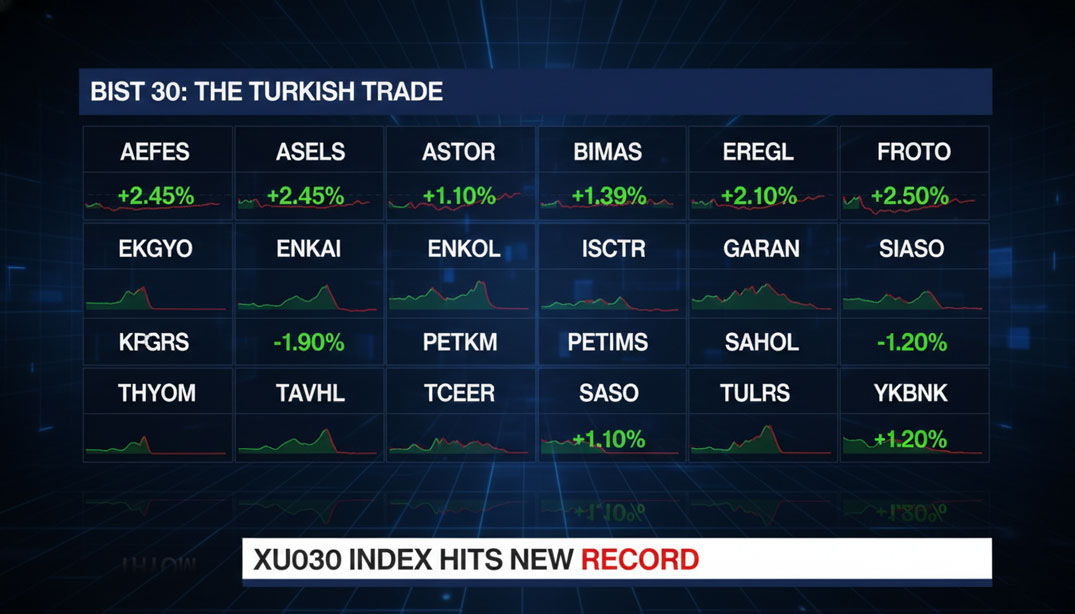
- FROTO (-2.50%), KCHOL (-1.79%), MGROS (-2.92%), PGSUS (-4.27%), SAHOL (-4.50%), TCELL (-3.53%), THYAO (-4.80%), TAVHL (-4.65%).
2. Emerging Bullish Indicators (Awaiting Confirmation)
In these cases, a “Stay in Cash” recommendation remains, but the probability of a “BUY” confirmation is considered high:
- SISE (-3.32%): “Bullish Descent Block” detected; potential bullish resurgence.
- EREGL (-0.74%) & GUBRF (-2.81%): “Bullish Harami” patterns detected; users are advised to “Watch Out” for a potential buy signal.
- ASTOR (-0.96%) & ASELS (-1.05%): “Bullish Stop-Loss” triggered. Bullish sentiment remains strong enough that a white candlestick could trigger a BUY signal.
3. Defensive/Cautionary Positions
- PETKM (-6.05%): Bears returned with “renewed vigor” after a failed bullish stop-loss trigger; the signal remains cash-only to avoid a “bull trap.”
- TOASO (-1.34%): “Bullish Matching Low” suggests a strong support level, but the probability of confirmation remains low.
- TRALT (-0.27%): Price is above confirmation level, but no BUY signal has been issued as the system maintains a cautious cash position.
——————————————————————————–
Technical Pattern Definitions
The analysis utilizes specific Japanese Candlestick terminology to define market transitions:
| Pattern | Type | Description |
| Bearish Engulfing | Top Reversal | A large black body completely engulfs a previous smaller white body. |
| Bearish Dark Cloud Cover | Top Reversal | Market opens at a new high (gap up) but closes more than halfway into the prior white body. |
| Harami (Bearish/Bullish) | Reversal | A small body (the “baby”) is contained within the range of a large previous body (the “mother”). |
| Bearish Tri Star | Top Reversal | Three consecutive Doji candlesticks; an extremely rare and noteworthy occurrence. |
| Bullish Descent Block | Reversal | Three consecutive black candlesticks closing lower in a downtrend; suggests a potential bottom. |
| Bearish Stop-Loss | Complement | Triggered by two consecutive lows or a close below the stop-loss level of a bullish pattern. |
| Bearish Deliberation | Reversal | Three consecutive white candlesticks with higher closes, but the market focus shifts downward. |